Physical Address
304 North Cardinal St.
Dorchester Center, MA 02124
Physical Address
304 North Cardinal St.
Dorchester Center, MA 02124

Your Guide to the Latest in Tech
Your Guide to the Latest in Tech
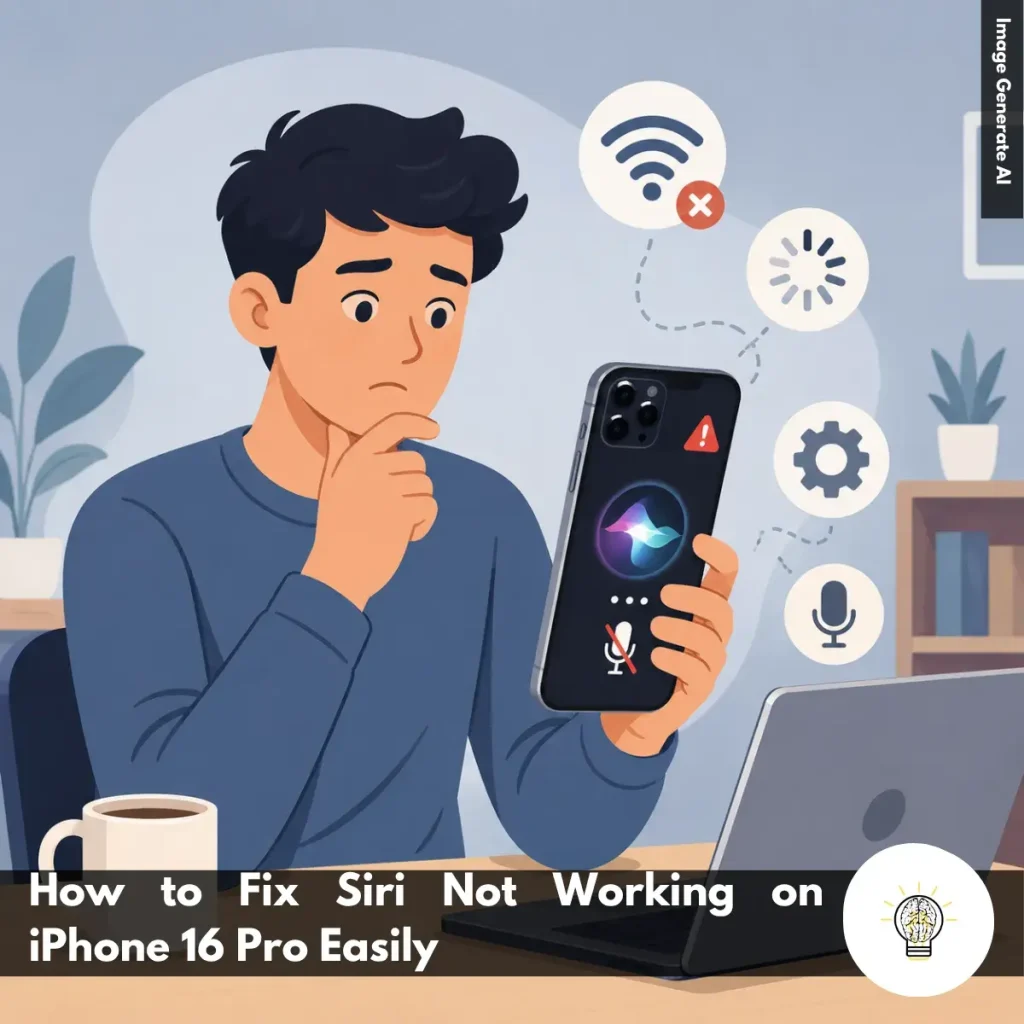
Ruminesia – Have you ever had Siri suddenly stop responding right when you actually needed it? Maybe you were trying to send a quick message, ask for directions, or use hands-free commands while driving, but Siri just stayed silent. Situations like this can feel surprisingly frustrating, especially on a device as advanced as the iPhone 16 Pro.
Interestingly, many people immediately assume there is something seriously wrong with their phone. In reality, most issues related to How to Fix Siri Not Working on iPhone 16 Pro are usually caused by small things like unstable internet connections, incorrect settings, or temporary iOS glitches that are easy to overlook.
What many users do not realize is that Siri depends on several system features working together at the same time. So when one setting changes or the connection becomes unstable, Siri can suddenly feel unreliable. The good news is that most of these problems can usually be fixed in just a few simple steps without needing professional repair.
Key Highlights
- Most Siri issues on iPhone 16 Pro come from settings or unstable internet connections.
- Restarting the iPhone often fixes temporary Siri glitches within seconds.
- Incorrect language or response settings can make Siri seem completely unresponsive.
- Low Power Mode may reduce Siri responsiveness during heavy or prolonged device usage.
- Network resets help when Siri fails only on certain Wi-Fi or mobile connections.
- Microphone blockage or damage is a commonly overlooked reason Siri cannot hear commands.
If you are wondering, “Is Siri Not Working on iPhone 16?”, there are currently no major widespread issues affecting Siri services. Most cases where Siri becomes unresponsive are usually temporary and can often be fixed with simple troubleshooting steps.
In many situations, the problem is related to software glitches, incorrect settings, or unstable internet connections rather than hardware damage. Since Siri relies heavily on Apple’s servers, weak Wi-Fi or poor mobile data can also affect its performance.
Users have reported several common issues with Siri on the iPhone 16 Pro, which can arise from technical glitches and configuration settings. Here’s a quick overview of these problems and their potential solutions:
If Siri suddenly stops responding on your iPhone 16 Pro, the problem usually comes from settings, connectivity, software glitches, or microphone-related issues. The good news is that most cases can be fixed in just a few minutes without visiting a service center. To make troubleshooting easier, start with the simplest fixes first before moving to deeper resets.
The first thing to verify is whether Siri is actually enabled. Open Settings > Siri & Search, then make sure Listen for “Hey Siri” is turned on. Without this setting, Siri won’t react to voice commands at all.
If you also use Siri hands-free while your iPhone is locked, enable Allow Siri When Locked.
Interestingly, even when everything already looks correct, Siri can still fail to respond because of a temporary configuration glitch. In practice, turning these options off and back on often refreshes Siri’s activation system and fixes detection issues immediately.
A quick restart can solve more problems than many users expect. Hold the volume button and side button until the power slider appears, then turn your iPhone off and back on.
This process clears temporary bugs and reloads system services that Siri depends on. It’s especially helpful if Siri stopped working after heavy multitasking, long usage sessions, or switching between multiple apps.
What many users don’t realize is that Siri runs alongside several background iOS processes. If one of those processes gets stuck, Siri may become slow, laggy, or completely unresponsive until the system refreshes.
Siri relies heavily on an internet connection to process commands. If your Wi-Fi or mobile data is unstable, Siri may fail to answer or stay stuck on the loading animation. Try these quick checks:
The problem is, unstable networks don’t always disconnect completely. Sometimes the connection is simply too weak for Siri to communicate properly with Apple’s servers.
If connectivity problems keep happening, resetting your network settings can help. Go to:
Settings > General > Transfer or Reset iPhone > Reset > Reset Network Settings
This removes saved Wi-Fi networks, VPN settings, and cellular configurations that may have become corrupted over time.
After the reset, reconnect to your Wi-Fi and test Siri again. This step is particularly useful when Siri only fails on certain networks rather than everywhere.
Software updates frequently include bug fixes for Siri and voice recognition features. Open Settings > General > Software Update and install any available updates.
Besides that, keeping iOS updated helps maintain compatibility between Siri and newer system functions. Older versions of iOS can sometimes create conflicts that affect voice processing, command recognition, or Siri activation reliability.
If Siri started malfunctioning after a recent update, installing the next patch often resolves those stability issues.
Sometimes Siri is actually working, but its voice responses are disabled. Go to:
Settings > Siri & Search > Siri Responses. Then select Prefer Spoken Responses.
This setting ensures Siri replies out loud instead of silently displaying text on screen. It also makes troubleshooting easier because you can immediately tell whether Siri is processing commands correctly.
Incorrect language or region settings can confuse Siri’s voice recognition. In Settings > Siri & Search, check that the selected language matches your accent and preferred region.
If Siri regularly misunderstands your commands, try switching to a closer regional variation. For example, different English variants can noticeably affect recognition accuracy.
What many users don’t realize is that Siri’s speech detection adapts differently depending on language profiles. A small adjustment here can sometimes improve response accuracy more than expected.
If none of the earlier fixes work, you can reset all system settings without deleting personal files. Go to:
Settings > General > Transfer or Reset iPhone > Reset > Reset All Settings
This restores system preferences like network settings, permissions, keyboard settings, and layouts back to default.
In practice, this works well when a deeper configuration conflict is preventing Siri from functioning properly. Your apps, photos, and personal data will remain untouched.
Siri depends on your iPhone’s microphones to hear commands clearly. Dust, debris, or even certain phone cases can block the microphone openings and reduce voice detection quality. Try these quick checks:
If recordings sound unclear, the issue may be hardware-related rather than software-related. Microphone problems are one of the most overlooked causes of Siri not working on iPhone 16 Pro.
Low Power Mode helps extend battery life, but it can also limit certain background activities that Siri relies on.
Go to Settings > Battery and temporarily disable Low Power Mode, then test Siri again.
When full system performance is restored, Siri often responds faster and more consistently. This is especially noticeable if Siri feels delayed, sluggish, or unreliable during low battery conditions.
Read More:
Many users are curious about the iPhone 16 not only because of the hardware upgrades, but also the everyday experience behind them. Here are some of the most common questions about the iPhone 16 before deciding whether the iPhone 16 is worth buying or upgrading to.
No, Apple Intelligence was not fully available immediately at launch. The first iPhone 16 models shipped with iOS 18, while many AI features arrived gradually through later updates like iOS 18.1.
In practice, Apple introduced features such as writing tools, notification summaries, and improved Siri capabilities in phases. This means the iPhone 16 experience continues evolving instead of delivering every AI feature on day one.
The Camera Control button is a new hardware shortcut placed on the right side of the iPhone 16 lineup. It allows users to instantly open the camera and adjust settings more naturally while shooting photos or videos.
Interestingly, the button also supports touch gestures and pressure sensitivity. Users can slide or lightly press it to control zoom, exposure, or camera modes without touching the main display.
No, the standard iPhone 16 still uses a 60Hz display. Apple continues to reserve 120Hz ProMotion technology for the Pro and Pro Max models.
The main difference is noticeable when scrolling or switching apps quickly. However, many users still find the iPhone 16 smooth enough because iOS animations remain highly optimized.
The iPhone 16 Pro features a larger 6.3-inch display, while the iPhone 16 Pro Max expands to 6.9 inches. This makes the Pro Max the biggest iPhone screen Apple has released so far.
Apple achieved this by reducing the bezel size rather than dramatically increasing the phone body. In practice, the larger display feels more immersive for gaming, editing, and media consumption.
The biggest differences are found in the display, camera system, materials, and chipset performance. The Pro models use titanium frames, 120Hz ProMotion displays, and more advanced camera hardware.
Meanwhile, the standard iPhone 16 focuses more on balanced everyday usability at a lower price point. For many users, the decision depends on whether advanced photography and smoother displays matter daily.
Yes, Apple redesigned the camera layout with vertically stacked lenses on the standard iPhone 16 and 16 Plus. This replaces the diagonal layout used in previous generations.
One thing many users overlook is that this change supports spatial video recording for the Apple Vision Pro ecosystem. The vertical arrangement helps capture more realistic depth information for immersive playback.
Yes, the iPhone 16 lineup offers better battery life compared to previous models. Apple combines larger batteries with more efficient A18-series chips for improved daily endurance.
In real-world usage, most users can comfortably get through a full day without needing to recharge midday. Improved thermal management also helps maintain battery health over time.
Yes, iPhone 16 models sold in the United States continue using eSIM only. Apple removed the physical SIM tray from US variants starting with earlier generations.
The system allows users to store multiple carrier profiles digitally through iOS settings. However, international versions of the iPhone 16 still include a physical nano-SIM slot.
The standard iPhone 16 comes in 128GB, 256GB, and 512GB storage variants. There is no microSD card support for expandable storage.
Because storage cannot be upgraded later, choosing the right capacity matters from the beginning. Users who shoot many videos or high-resolution photos may benefit from larger storage options.
Some early users reported occasional touchscreen responsiveness problems near the screen edges. The issue was mainly related to Apple’s palm rejection software sensitivity.
Because the bezels are thinner, the system sometimes misinterprets normal hand placement as accidental touches. Apple has addressed many of these complaints through iOS software updates.
Sometimes Siri problems feel bigger than they actually are. But interestingly, most cases related to How to Fix Siri Not Working on iPhone 16 Pro usually come down to small settings changes, unstable connections, or temporary system glitches that quietly interfere in the background.
What many users realize after troubleshooting is how much modern smartphone features depend on multiple systems working together smoothly. Siri may seem simple on the surface, but even something minor like Low Power Mode, microphone blockage, or incorrect language settings can completely change how it responds in daily use.
In the end, fixing Siri is often less about complicated repairs and more about patiently checking the basics one by one. Maybe you’ve experienced a similar issue where the simplest fix turned out to be the right one. What’s your experience with Siri on the iPhone 16 Pro so far?