Physical Address
304 North Cardinal St.
Dorchester Center, MA 02124
Physical Address
304 North Cardinal St.
Dorchester Center, MA 02124

Your Guide to the Latest in Tech
Your Guide to the Latest in Tech
Ruminesia – An air purifier is one of those devices you may barely notice once it becomes part of your routine. You turn it on, leave it running, and eventually stop thinking about it—until you start wondering whether it is actually doing enough for your room. That was one of the things I wanted to understand after using the Xiaomi Air Purifier 4 Compact for almost two years.
Its compact size, relatively low power consumption, and simple controls make the Xiaomi Air Purifier 4 Compact an interesting option for bedrooms and personal spaces. But specifications alone do not tell you whether a purifier is practical to live with, especially when you use it regularly.
So, rather than looking only at the numbers, this review focuses on what the Compact offers, where its limitations become noticeable, how much the filter costs, and what I learned from using it over the long term.
Key Highlight
- The Xiaomi Air Purifier 4 Compact fits bedrooms and personal spaces up to around 27 m².
- Its compact 2.2 kg design makes moving the purifier between rooms relatively easy.
- Sleep Mode, rated at 20 dB, makes it practical for regular nighttime use.
- The 230 m³/h CADR is suitable for smaller rooms, but limiting for larger spaces.
- Replacement filters add a recurring cost that should factor into the buying decision.
- After almost two years, consistency and room suitability matter more than having the highest specifications.
The Xiaomi Air Purifier 4 Compact is a small air purifier designed for personal spaces such as bedrooms, home offices, or other rooms measuring around 16–27 m². It has a CADR of 230 m³/h, meaning it can circulate and filter a substantial amount of air for a device of its size. Measuring Φ220 × 355 mm and weighing about 2.2 kg, it also takes up relatively little space.
Think of it this way: the Compact is built for a specific room size rather than an entire home. Its small footprint makes it easier to place in a bedroom or workspace, as long as there is enough clearance around the air intake and outlet for proper airflow.
That positioning is what makes the Xiaomi Air Purifier 4 Compact practical for certain users. If you mainly want to improve air quality in one bedroom or a personal workspace, a 230 m³/h purifier may make more sense than buying a much larger model with capacity you may never fully use.
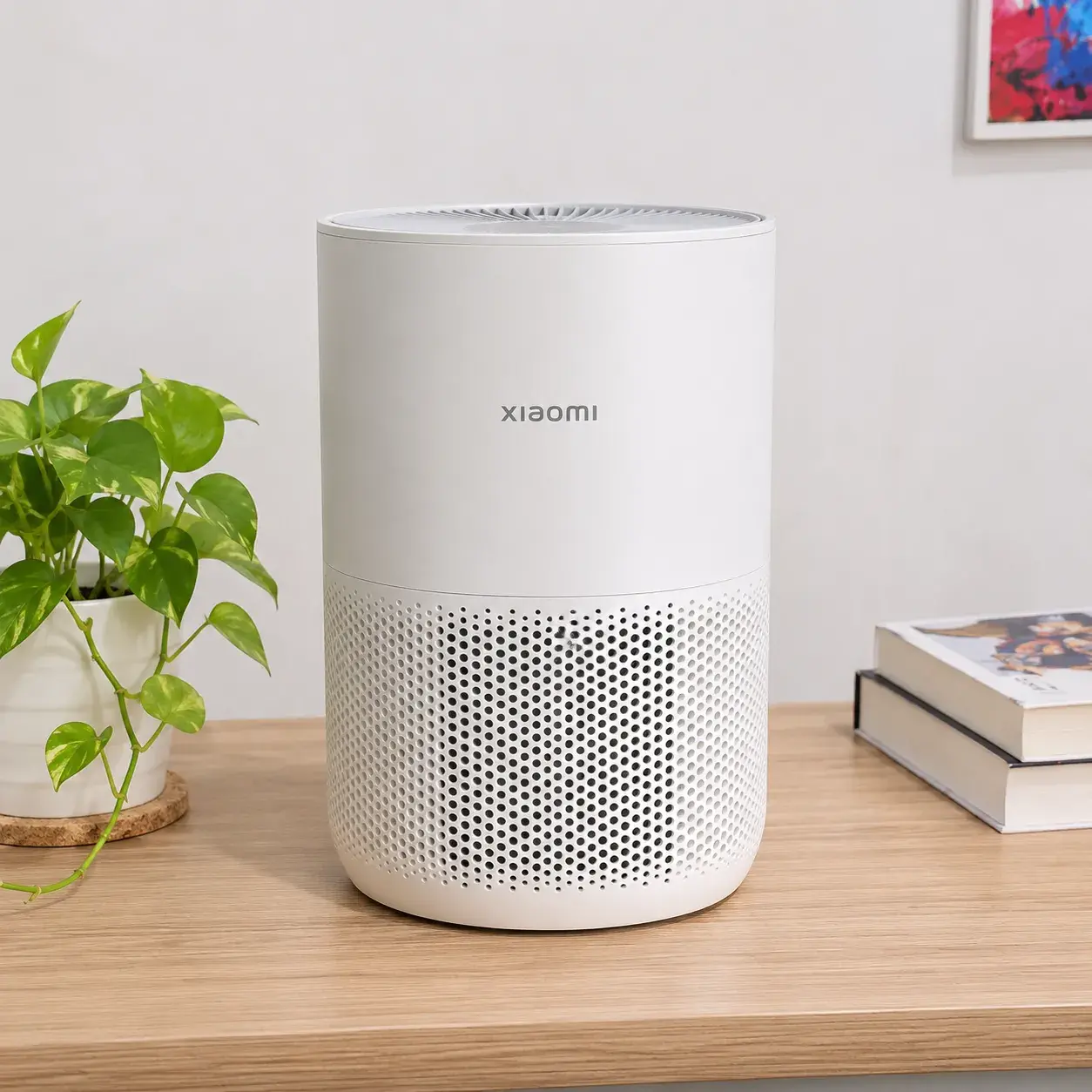
Specifications help you understand what the Xiaomi Air Purifier 4 Compact can realistically handle. After almost two years of use, I’d treat these numbers as a reference for understanding the device rather than the only reason to buy it.
| Specification | Xiaomi Air Purifier 4 Compact |
|---|---|
| Model | AC-M18-SC |
| Dimensions | Φ220 × 355 mm |
| Weight | Approx. 2.2 kg |
| Effective coverage | 16–27 m² |
| Particle CADR | 230 m³/h |
| Filtration | Pre-filter + Xiaomi High Efficiency Filter + activated carbon |
| Filtration efficiency | Up to 99.97% for 0.3 μm particles |
| Sensor | Infrared PM2.5 sensor |
| Modes | Auto, Sleep, Manual |
| Sleep mode noise | 20 dB |
| Maximum power | 27 W |
| Connectivity | 2.4 GHz Wi-Fi |
| App | Xiaomi Home/Mi Home |
| Voice control | Google Assistant & Amazon Alexa* |
| Filter lifespan | 6–12 months |
| Replacement filter | AFEP7TFM01 |
| Certification | TÜV Rheinland Allergy Care |
*Voice control availability may vary depending on your region, language, and device.
One detail is worth clarifying because some online listings get it wrong. The Xiaomi Air Purifier 4 Compact does not have temperature and humidity sensors. Instead, it uses an infrared particle sensor to monitor PM2.5. Temperature and humidity sensing is available on models such as the Xiaomi Air Purifier 4 Lite.
The Xiaomi Air Purifier 4 Compact has a few features that matter more in everyday use than the headline specifications suggest. The most useful ones are its filtration system, air-quality indicator, and smart controls.
The Xiaomi Air Purifier 4 Compact uses three filtration layers: a pre-filter, Xiaomi High Efficiency Filter, and activated carbon. The pre-filter handles larger particles, while the main filter targets finer particles. The activated carbon layer also helps reduce certain odors and compounds in the air.
Xiaomi claims the High Efficiency Filter can achieve up to 99.97% filtration efficiency for particles as small as 0.3 microns. The system combines mechanical filtration with electrostatic material to maintain filtration efficiency without restricting airflow too much.
The purifier also carries TÜV Rheinland Allergy Care certification, which relates to filtration performance against certain allergens, including pollen, dust mites, and pet dander.
There is one detail worth keeping in mind: 99.97% does not mean the air in your entire room becomes 99.97% cleaner. The figure refers to the filter’s efficiency against specific particles under testing conditions. Room size, airflow, filter condition, and how long the purifier runs all affect the actual result.
One of the easiest features to understand is the color indicator on top of the device. Instead of constantly opening the app, I can simply check the indicator color to get a quick idea of the particle levels in the air.
If you want to learn more about the Xiaomi Air Purifier 4 Compact light colors, including the PM2.5 ranges, why the indicator suddenly turns red, and what the icons on the top panel mean, I’ve covered those details in a separate article.
In general, the indicator is divided into four categories based on PM2.5 concentration:
| Color | PM2.5 Concentration |
|---|---|
| Green | 1–35 µg/m³ |
| Yellow | 36–75 µg/m³ |
| Orange | 76–150 µg/m³ |
| Red | >150 µg/m³ |
When using Auto Mode, the device can adjust the fan speed based on the detected air conditions. For me, a simple indicator like this is more practical for everyday use because I don’t need to check the PM2.5 reading on my smartphone every time.
The Xiaomi Air Purifier 4 Compact can connect to the Xiaomi Home app, allowing you to control the purifier from your smartphone. You can change operating modes, check air-quality information, set schedules, and manage other available settings.
This becomes particularly useful when the purifier is in a bedroom or another part of the house. Instead of walking over to the unit every time you want to change a setting, you can do it from your phone as long as the purifier and network are working normally.
The Compact also supports Google Assistant and Amazon Alexa on compatible devices and in supported regions. If you already use either ecosystem, voice control can be a useful bonus rather than a reason to buy the purifier on its own.
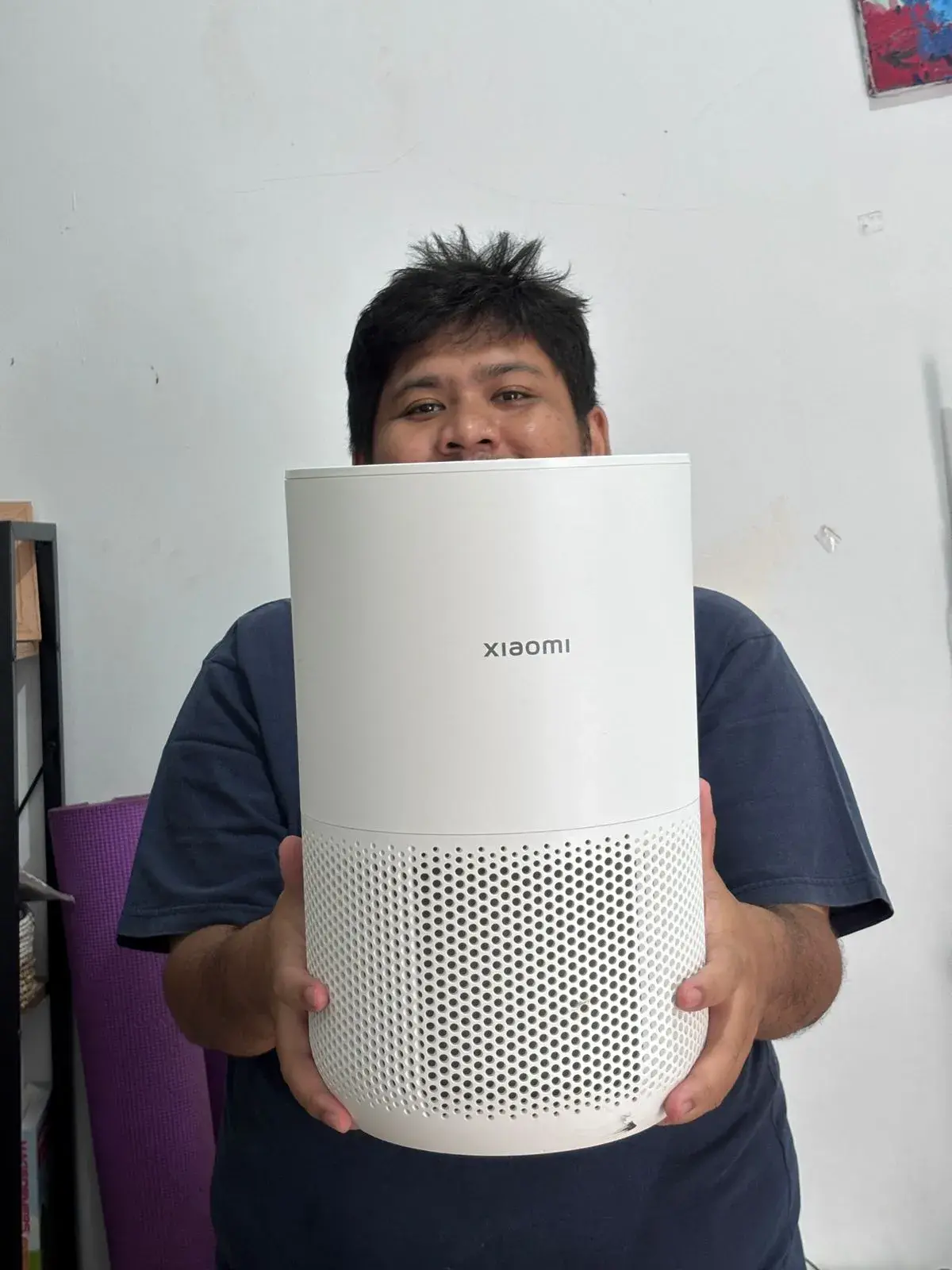
Specifications tell you what a product is supposed to do. Long-term use tells you whether it actually fits into your routine.
After almost two years with the Xiaomi Air Purifier 4 Compact, I look at it differently than I did when I first bought it. The 230 m³/h CADR and 99.97% filtration claim are useful reference points, but the more practical question is simpler: does the purifier remain useful after becoming part of your daily routine?
The Xiaomi Air Purifier 4 Compact is small enough that it doesn’t demand a dedicated corner of the room. At around 35.5 cm tall and 22 cm in diameter, it can fit comfortably in spaces where a larger air purifier would feel intrusive.
Its 2.2 kg weight also makes it relatively easy to move. For me, this becomes more noticeable over time. If I want to use it in the bedroom, I can place it there without much hassle. Moving it to another room is just as straightforward.
That flexibility is one of the Compact’s more useful advantages. You don’t necessarily need a separate purifier for every room if your needs are limited and you’re willing to move the unit around.
Still, small doesn’t mean you can put it anywhere. Keep enough space around the air intake and outlet so the airflow isn’t blocked.
The built-in PM2.5 sensor is one of the features I pay attention to most. The color indicator gives me a quick visual reference without having to open the Xiaomi Home app every time.
In daily use, changes in the indicator can remind you that indoor air conditions aren’t always constant. Activities that introduce smoke or particles into the room, for example, can cause the reading to change.
That said, I wouldn’t treat the sensor as professional air-quality equipment. The infrared sensor is designed to help the purifier monitor conditions and adjust its operation, not to replace laboratory-grade measurement equipment.
This distinction matters. The indicator is useful for understanding changes, but it shouldn’t be interpreted as a precise measurement of everything happening in your indoor air.
Sleep Mode is one of the reasons I still find the Compact easy to live with. Xiaomi rates the noise level at around 20 dB in this mode, keeping fan noise relatively low.
At night, that matters. A purifier can have excellent filtration, but if its noise constantly distracts you while sleeping, you’re less likely to keep using it consistently.
The indicator light can also be turned off, which helps when you want the room completely dark. These sound like minor details, but they become more relevant when a device is expected to run for hours while you sleep.
The Xiaomi Air Purifier 4 Compact has a maximum rated power consumption of 27 W. Using a simple worst-case calculation, running it continuously for 24 hours a day over 30 days would consume:
- 27 W × 24 hours × 30 days = 19.44 kWh per month
At an electricity rate of Rp1,444.70 per kWh, that works out to roughly Rp28,000 per month if the purifier somehow stayed at maximum power the entire time.
Real-world usage won’t work exactly like that. Auto and Sleep modes don’t necessarily keep the purifier running at maximum power continuously, so the Rp28,000 figure is better viewed as a simple upper-bound estimate rather than a guaranteed monthly electricity cost.
After almost two years, the biggest thing I’ve noticed is that an air purifier isn’t the kind of device that constantly gives you an obvious visual result. It’s not a vacuum cleaner where you can immediately see what you’ve collected.
Most of its work happens in the background. It keeps filtering the air while you’re working, relaxing, or sleeping.
That’s why consistency matters more to me than chasing the biggest specifications. A purifier that fits your room, doesn’t get in the way, and is easy enough to run every day can make more sense than a much more powerful model that ends up sitting unused.
After looking at the specifications and almost two years of use, the strengths and limitations of the Xiaomi Air Purifier 4 Compact become easier to judge. It has a clear purpose, and that also makes it easier to see where the device starts to fall short.
For a bedroom or personal workspace, these limitations are fairly easy to live with. The calculation changes when you want one purifier to handle a large or open area. In that situation, the Compact’s 230 m³/h CADR becomes the bigger limitation, regardless of how good the rest of its feature set looks.
Buying the purifier is only part of the cost. The filter is a consumable component, so anyone planning to use the Xiaomi Air Purifier 4 Compact for years should factor replacement costs into the ownership budget.
The compatible replacement filter is AFEP7TFM01. Xiaomi Indonesia currently lists it at a promotional price of Rp279,000, with a regular listed price of Rp429,000. Prices can change depending on the promotion period.
With an estimated filter lifespan of 6–12 months, using the regular Rp429,000 price works out to roughly Rp35,750–Rp71,500 per month when averaged across its lifespan. This doesn’t mean you’re paying that amount every month; it’s simply a way to estimate the long-term cost.
For routine maintenance, you can remove dust from the exterior and accessible areas with a soft cloth or vacuum cleaner. Avoid washing the filter with water. Once the filtration media reaches the end of its usable life, replacing it is the appropriate approach.
Replacing the Xiaomi Air Purifier 4 Compact Filter is relatively straightforward. You don’t need to take the purifier apart or use specialized tools.
If you use the purifier every day, don’t rely on the calendar alone. Check the filter condition and the filter-life indicator in the app as additional references when deciding when it’s time for a replacement.
If you’re looking for the practical side of using the purifier, I’ve also put together a Xiaomi Air Purifier 4 Compact Manual covering the initial setup, Xiaomi Home connection, operating modes, filter replacement, and common troubleshooting steps.
It’s useful to keep as a reference if you’ve just bought the purifier or need to check a specific setting later.
The Xiaomi Air Purifier 4 Compact and Xiaomi Air Purifier 4 Lite are often compared because both belong to Xiaomi’s air purifier lineup and share a similar minimalist design. The difference becomes clearer when you look at their size, cleaning capacity, and sensor features.
| Feature | Xiaomi Air Purifier 4 Compact | Xiaomi Air Purifier 4 Lite |
|---|---|---|
| Dimensions | Φ220 × 355 mm | 240 × 240 × 533.5 mm |
| Weight | Approx. 2.2 kg | Approx. 4.8 kg |
| Effective area | 16–27 m² | 25–43 m² |
| CADR | 230 m³/h | 360 m³/h |
| PM2.5 sensor | Infrared | Laser |
| Temperature & humidity sensor | No | Yes |
| PM2.5 numerical display | No | Yes |
| Sleep Mode | 20 dB | 33.4 dB |
| Maximum power | 27 W | 33 W |
So, the Lite is not simply a larger version of the Compact. It also offers a higher cleaning capacity and more detailed air-quality information.
If your room is around 16–27 m², the Xiaomi Air Purifier 4 Compact makes a lot of sense. Its smaller body and lighter 2.2 kg weight also make it easier to move between rooms when needed. For a bedroom or personal workspace, that smaller footprint can be more practical than buying a larger purifier than you actually need.
The Xiaomi Air Purifier 4 Lite, on the other hand, is better suited to larger rooms, with an effective area of around 25–43 m² and a higher CADR of 360 m³/h. It also gives you more information at a glance through its numerical PM2.5 display, plus temperature and humidity readings.
Interestingly, the choice does not really come down to which model has more features. It comes down to what you need from the purifier. For a smaller room and simple everyday use, the Compact is the more practical choice. If you have a larger room or want more detailed sensor information, the Lite is the better fit.
The price of the Xiaomi Air Purifier 4 Compact can change depending on promotions, marketplace discounts, and where you buy it. Because of that, it is better to look beyond the product’s sticker price and consider the cost of replacement filters as well.
At the time of checking Xiaomi Indonesia, the Xiaomi Air Purifier 4 Compact was listed at around Rp1.499 million. Marketplace prices may be lower or higher depending on vouchers, seasonal promotions, and individual sellers. Before buying, there are a few things worth checking:
One more thing to keep in mind is Xiaomi’s warranty policy. Products sold within the Mi Ecosystem do not necessarily share identical warranty terms. The coverage can depend on the model and where the product was purchased, so checking the applicable Xiaomi Indonesia warranty information before checkout is worth the extra minute.
Still deciding whether the Xiaomi Air Purifier 4 Compact is right for your room? Here are the questions that come up most often, answered based on its specifications and almost two years of use.
The Xiaomi Air Purifier 4 Compact is designed for rooms around 16–27 m², with a particle CADR of 230 m³/h. In practice, it is better suited to bedrooms, home offices, and other personal spaces than large or open areas.
The Xiaomi Air Purifier 4 Compact has a maximum power consumption of 27 W. If it ran continuously at maximum power for 24 hours a day over 30 days, it would use about 19.44 kWh, equivalent to roughly Rp28,000 at an electricity rate of Rp1,444.70/kWh. Actual consumption can be lower because 27 W is the maximum rating.
The filter is designed to last around 6–12 months. Actual replacement timing depends on air quality, how often you use the purifier, and the conditions in your room.
No. The filter is not designed to be washed with water. You can clean dust from the purifier and its accessible air passages, but the filter should be replaced when it reaches the end of its usable life.
The Xiaomi Air Purifier 4 Compact connects to the Xiaomi Home app through a 2.4 GHz Wi-Fi network. Once the purifier is added to the app, you can control its modes, set schedules, and check device information from your smartphone.
Yes. Its Sleep Mode is rated at around 20 dB. In my experience, the sound is low enough for nighttime use, especially when the purifier is positioned at a reasonable distance from your head.
The four colors indicate different PM2.5 ranges:
The indicator gives you a quick visual reference for changes in air quality without opening the Xiaomi Home app.
The Xiaomi Air Purifier 4 Compact has TÜV Rheinland Allergy Care certification and is designed to help filter certain allergens, including pet dander. Xiaomi also rates its filter at up to 99.97% filtration efficiency for 0.3-micron particles under specified testing conditions.
Start by checking the sensor area and making sure it is clean and unobstructed. Dust around the sensor, the purifier’s placement, and surrounding airflow can affect its readings. Also remember that the Compact uses an infrared PM2.5 sensor, so its readings should be treated as a useful reference rather than professional air-quality measurements.
The main difference is capacity. The Xiaomi Air Purifier 4 has a CADR of 400 m³/h and is rated for around 28–48 m², while the Compact has a CADR of 230 m³/h and is rated for 16–27 m². The larger Air Purifier 4 also uses a laser PM2.5 sensor and has an OLED display, making it a better fit for larger rooms and users who want more detailed air-quality information.
After almost two years with the Xiaomi Air Purifier 4 Compact, I see it less as a gadget that needs to impress you and more as a device that needs to fit quietly into your routine. Its compact size, low power draw, and simple controls make sense for a bedroom or personal workspace, as long as the room is within its intended capacity.
What I find more important is consistency. An air purifier does its job in the background, so its value is not always something you can immediately see or feel. For me, the Compact works because it is easy enough to keep running regularly without taking up much space or adding too much complexity.
If you’re considering the Xiaomi Air Purifier 4 Compact, the real question is not whether it has the most advanced features. It is whether its capacity, running cost, and limitations match the room you actually want to use it in. If you already use one, I’d be interested to hear how it has worked for you.


