Physical Address
304 North Cardinal St.
Dorchester Center, MA 02124
Physical Address
304 North Cardinal St.
Dorchester Center, MA 02124

Your Guide to the Latest in Tech
Your Guide to the Latest in Tech

ruminesia – One of the things I considered when I first started using the Xiaomi Air Purifier 4 Compact was electricity consumption. I live in Indonesia, where electricity costs are usually discussed in terms of the home’s VA capacity and the electricity tariff per kWh, so I wanted to know whether leaving a small air purifier running for long periods would noticeably affect my bill.
The purifier is small, but I use it in my bedroom almost continuously. There are even days when I leave it running for 24 hours.
After around two years of using the Xiaomi Air Purifier 4 Compact, I haven’t noticed a significant increase in my household electricity consumption because of it. However, I never measured my unit with a wattmeter, so I won’t claim that it uses a specific number of watts on average.
The official specification gives us a useful starting point: Xiaomi lists a maximum power consumption of 27 W for the Air Purifier 4 Compact. That number can look larger when you immediately multiply it by 24 hours, but 27 W is the maximum rated power, not necessarily what the purifier draws continuously.
Key Highlights
- The Xiaomi Air Purifier 4 Compact has a maximum power consumption of 27 W.
- At 27 W running continuously for 24 hours, it would use about 0.648 kWh per day.
- Over 30 days, that would equal 19.44 kWh.
- Using the Indonesian residential electricity rate of Rp1,444.70/kWh for the 1,300 VA example in this article, the theoretical cost would be around Rp28,085 per month.
- This is a maximum-power calculation, not a measurement of actual daily consumption.
- In my experience using the purifier for around two years, leaving it on for 24 hours has not caused a noticeable increase in my electricity usage.
- The replacement filter is another cost to consider when calculating the long-term cost of owning the purifier.
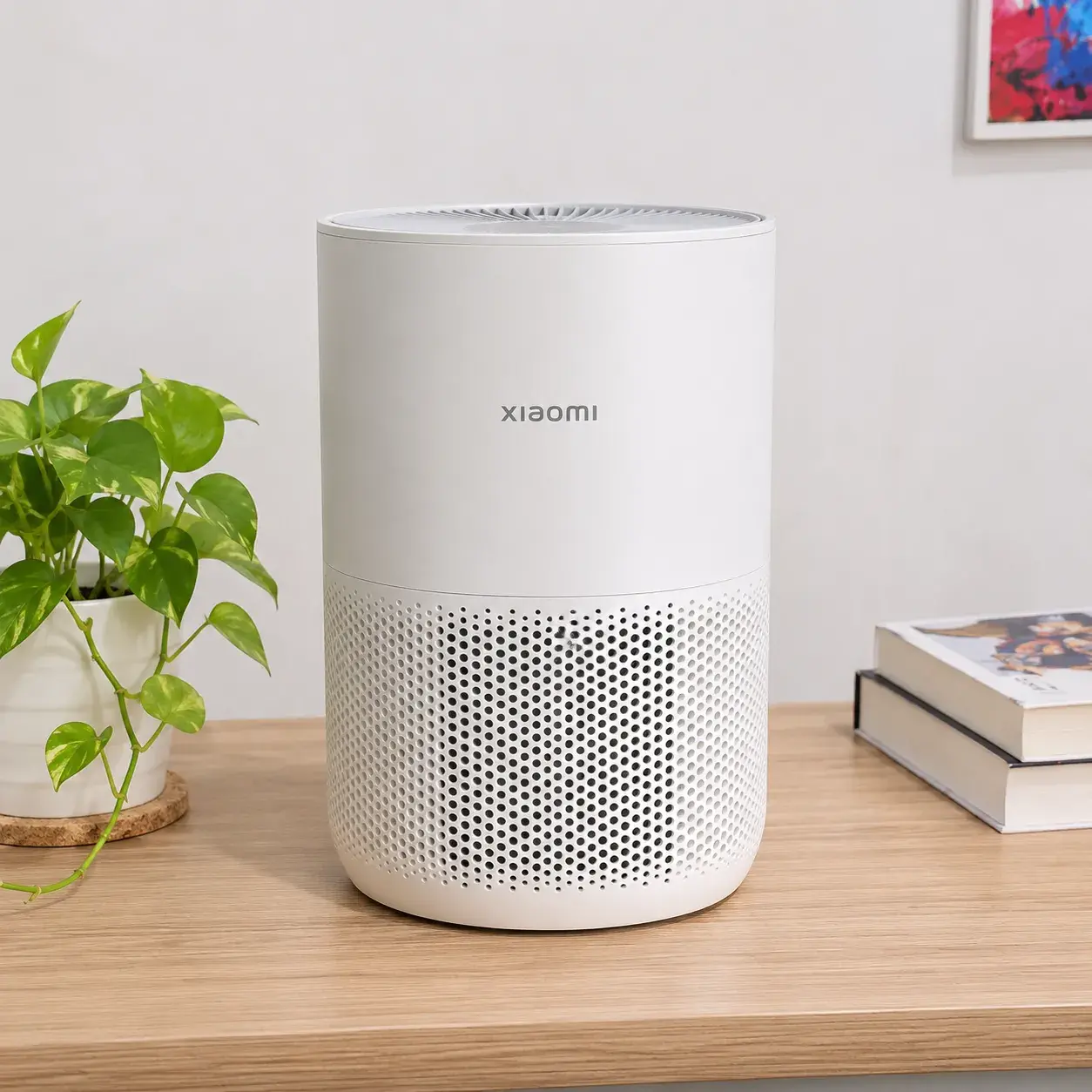
The simple answer is up to 27 W.
Xiaomi lists a maximum power consumption of 27 W for the Xiaomi Smart Air Purifier 4 Compact. The purifier also has a Particle CADR of 230 m³/h and is designed for an effective area of around 16–27 m².
However, there is an important difference between maximum power and actual electricity consumption.
Think of it like a fan. If a fan is rated at 50 W, that doesn’t necessarily mean it draws exactly 50 W continuously under every condition. The same idea applies to an air purifier.
The Xiaomi Air Purifier 4 Compact has an Auto Mode that can adjust its purification speed based on the detected particle conditions. When the air is relatively clean, it doesn’t need to work as hard as it would when the sensor detects more particles.
So, I would treat the 27 W figure as the upper limit used for calculation, rather than assuming the purifier consumes 27 W throughout the entire day.
The simplest calculation is:
Power (W) × Time (hours) ÷ 1,000 = Electricity consumption (kWh)
Using the maximum rated power of 27 W:
27 × 24 ÷ 1,000 = 0.648 kWh per day
Over 30 days:
0.648 × 30 = 19.44 kWh per month
So, if the Xiaomi Air Purifier 4 Compact actually consumed its maximum 27 W continuously for 24 hours a day, it would use approximately 19.44 kWh per month.
This is a theoretical calculation. Actual consumption can be different because the purifier does not necessarily operate at maximum power all the time.
Because I’m based in Indonesia, I use an Indonesian electricity tariff for the cost example in this article.
My home uses a 1,300 VA residential electricity connection. For the calculation here, I use a tariff of Rp1,444.70 per kWh.
If you’re reading this from another country, don’t treat Rp1,444.70 as a universal electricity rate. Your actual cost will depend on your local tariff, taxes, fixed charges, and electricity plan.
Using the Indonesian rate in my example:
19.44 kWh × Rp1,444.70 = approximately Rp28,085 per month
So, if the Xiaomi Air Purifier 4 Compact really used its maximum 27 W continuously, the theoretical electricity cost would be around Rp28,000 per month based on the Indonesian tariff used here.
For me, that’s a relatively small amount for a device that can run throughout the day.
However, there’s an important distinction here: Rp28,000 is not a prediction of how much your electricity bill will increase every month.
It’s a calculation based on the assumption that the purifier continuously consumes its maximum rated power.
The 27 W figure is easy to misunderstand.
If you see “27 W” in the specifications, it doesn’t mean the purifier necessarily consumes 27 W every hour. It means the device is rated for a maximum power draw of 27 W.
Actual electricity consumption can change depending on how the purifier is operating.
For example, the purifier can adjust its purification speed in Auto Mode based on the detected air conditions. A unit operating at a lower fan speed doesn’t necessarily have the same power consumption as one working at its highest speed.
That’s why I don’t think it’s accurate to simply say, “The Xiaomi Air Purifier 4 Compact uses 27 W.”
A more accurate statement is: the Xiaomi Air Purifier 4 Compact has a maximum rated power of 27 W.
Xiaomi’s product information also mentions around 0.7 kWh for 24 hours of purification, based on the 27 W × 24-hour calculation.
There is a small mathematical difference worth pointing out.
The calculation is:
27 × 24 ÷ 1,000 = 0.648 kWh
If rounded to one decimal place, this is about 0.6 kWh. Xiaomi’s figure of around 0.7 kWh can therefore be understood as a rough rounded figure.
For the calculations in this article, I prefer to use 0.648 kWh because it is the direct result of the calculation.
The difference doesn’t have a major impact on the estimated monthly cost.
If you only look at the 27 W figure, it can make the purifier seem more power-hungry than it actually is.
Assuming the maximum 27 W consumption for 24 hours a day over 30 days gives us 19.44 kWh per month.
At the Indonesian electricity rate of Rp1,444.70/kWh used in my example, that works out to approximately Rp28,000 per month.
I don’t find that particularly concerning for a device that I use every day.
More importantly, this is still a maximum-power scenario, not a measurement of the purifier’s actual monthly consumption.
This is the part I find more useful than simply looking at the wattage on paper.
I’ve been using the Xiaomi Air Purifier 4 Compact for around two years. In everyday use, I often leave it running continuously, including while I’m sleeping or when I’m not paying much attention to it.
I haven’t used a wattmeter to record its electricity consumption. So I can’t honestly say that my unit averages, for example, 5 W or 8 W per hour.
What I can talk about is my experience with the electricity bill.
After using the purifier for around two years, I haven’t noticed a significant increase in my household electricity consumption even though I often leave it running for 24 hours.
Of course, this isn’t a laboratory measurement. Many other appliances also affect household electricity usage. But based on my experience, the Air Purifier 4 Compact hasn’t been a device that made my electricity consumption noticeably jump.
That’s one reason I’m comfortable leaving it on for long periods.
For me, the more important questions are whether it helps maintain the air conditions in my bedroom and whether the filter is still in good condition.
You can find websites that measure the Xiaomi Air Purifier 4 Compact with a wattmeter and report power consumption for different modes.
Those measurements can be useful references. However, I don’t want to present them as Ruminesia’s own measurements because I didn’t perform those tests myself.
Actual power consumption can also vary depending on several factors:
For this article, I prefer to keep three different things separate:
I think this is more transparent than taking a wattmeter measurement from another website and presenting it as if I had tested the purifier myself.
For me, yes.
The Xiaomi Air Purifier 4 Compact has an Auto Mode that allows the purifier to adjust its purification speed based on changes detected by its sensor.
That means there’s little reason to keep the purifier running at maximum speed when the air conditions are already good.
For everyday use, I prefer letting the purifier operate automatically. When particle levels increase, the fan can work harder. Once conditions improve, it doesn’t need to keep running at a high speed.
This makes more sense to me when using the purifier throughout the day because I don’t have to manually change the fan speed all the time.
If you’re using the purifier in a bedroom, Sleep Mode is another practical option.
Xiaomi lists the noise level at around 20 dB in Sleep Mode, which is designed for quieter operation while sleeping.
I appreciate this because a purifier running throughout the night can become annoying if the fan is too loud.
For me, Sleep Mode is useful when I mainly want to keep the bedroom air in good condition while avoiding unnecessary fan noise at night.
Electricity isn’t the only running cost you should consider.
Xiaomi lists an estimated filter lifespan of around 6–12 months for the Air Purifier 4 Compact. The replacement filter model is AFEP7TFM01.
That means the long-term cost of owning the purifier isn’t just about electricity.
For example, if a filter lasts one year, you can divide its purchase price by 12 to estimate its monthly cost. This gives you a more realistic idea of the total cost of running the purifier.
I actually think this is a better way to look at the cost than focusing only on the electricity bill.
If the electricity cost is only a few tens of thousands of rupiah per month under the maximum-power scenario, the replacement filter can become a more noticeable part of the long-term ownership cost.
If your goal is to maintain the air in a bedroom throughout the day, I don’t think 24-hour use is something you need to worry about too much from an electricity perspective.
The purifier’s maximum rated power is 27 W. Even when using that figure for an extreme calculation, the result is about 19.44 kWh per month.
At the Rp1,444.70/kWh rate used in my Indonesian example, that’s approximately Rp28,000 per month.
Again, this isn’t a prediction of your actual electricity bill.
If you want to know exactly how much electricity your own Air Purifier 4 Compact uses, the best approach is to measure it with a wattmeter or a smart plug that can track electricity consumption.
In my case, around two years of using the purifier has been enough for me to stop worrying too much about electricity when leaving it on throughout the day.
If you still want to keep electricity use under control, a few simple habits can help:
In my opinion, choosing an air purifier shouldn’t come down to one question: “How many watts does it use?”. For the Xiaomi Air Purifier 4 Compact, I would also consider:
The Xiaomi Air Purifier 4 Compact has a Particle CADR of 230 m³/h and an effective area of around 16–27 m².
That makes it more suitable for a bedroom or personal space than a much larger room. If the room is too large for the purifier’s intended coverage, the device may need to work harder to achieve the air conditions you want.
In that situation, choosing an air purifier based on the room size is more important than simply looking for the lowest wattage.
Using Xiaomi’s maximum rated power of 27 W as the basis, the calculation looks like this:
| Calculation | Result |
|---|---|
| Maximum power | 27 W |
| 24-hour consumption | 0.648 kWh |
| 30-day consumption | 19.44 kWh |
| Indonesian electricity rate used | Rp1,444.70/kWh |
| Theoretical monthly cost | ~Rp28,085 |
The important word here is theoretical.
I wouldn’t say, “The Xiaomi Air Purifier 4 Compact costs Rp28,000 per month to run.”
A more accurate way to put it is:
If the purifier actually consumes its maximum 27 W continuously for 24 hours a day over 30 days, the theoretical electricity cost would be around Rp28,000 per month using the Indonesian electricity rate in this example.
Actual consumption can be different.
And if you’re outside Indonesia, you can simply replace Rp1,444.70 with your own electricity rate to calculate the equivalent cost in your country.
Based on my own experience using the Xiaomi Air Purifier 4 Compact for around two years, leaving it on for 24 hours has not made me feel that my household electricity consumption increased significantly.
Related Articles
Here are some common questions about the electricity consumption and running cost of the Xiaomi Air Purifier 4 Compact.
The Xiaomi Air Purifier 4 Compact has a maximum rated power of 27 W. This is the maximum figure, not an indication that the purifier continuously consumes 27 W.
Assuming the maximum 27 W consumption for 24 hours, it would use approximately 0.648 kWh per day.
At 27 W continuously for 30 days and the Indonesian electricity rate of Rp1,444.70/kWh used in this article, the theoretical cost is approximately Rp28,085 per month. Actual consumption can be lower.
I don’t consider it expensive based on the maximum 27 W rating. Actual consumption does not necessarily stay at the maximum, and after around two years of frequent 24-hour use, I haven’t noticed a significant increase in my household electricity consumption.
From my experience, yes. I frequently leave mine running for 24 hours, including overnight. From an electricity perspective, its maximum rated power is relatively low.
Sleep Mode is designed for quieter operation at night, with Xiaomi listing around 20 dB of noise. Auto Mode is more flexible because it can adjust purification speed based on detected air conditions.
Xiaomi lists an estimated filter lifespan of around 6–12 months, depending on usage and environmental conditions.
The compatible replacement filter uses the model number AFEP7TFM01.
It depends on the filter price and how long the filter lasts. For that reason, replacement filter costs should be included when calculating the total long-term cost of owning the purifier.
The most accurate method is to use a wattmeter or a smart plug with electricity monitoring. The 27 W specification only tells you the maximum rated power; actual consumption can change depending on how the purifier is being used.
The Xiaomi Air Purifier 4 Compact has a maximum power rating of 27 W, which is modest for a device designed to run for long periods.
If you assume the purifier consumes the full 27 W continuously, the calculation comes to 0.648 kWh per day or 19.44 kWh per month. Using the Indonesian electricity rate in my example, that’s roughly Rp28,000 per month.
But that number should be treated as a theoretical maximum, not a prediction of your actual electricity bill.
For my own use, I’ve been running the Air Purifier 4 Compact frequently for around two years, including 24-hour periods, and I haven’t noticed a significant increase in household electricity consumption.
If you want a precise number for your own unit, though, a wattmeter is still the better answer than any calculation based only on the specification.